Four Friends, One Promise - World Brain Tumor Day
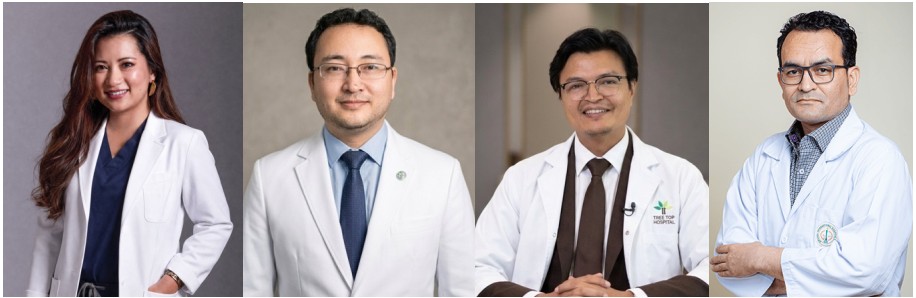
How four neurosurgeons born of the same canteen, the same dream, and the same heartbreak built Nepal's Neurocare Foundation
There is a particular kind of pain that does not belong to the patient alone. It belongs to everyone who watches — to the nurse who cannot explain why the man arrived on day seven, to the resident who knows, with cold certainty, that the golden window has closed. It belonged, for years, to four young medical students in Kathmandu who could not look away.
They saw the stroke patient who had lain at home for a week, his family burning incense and reciting prayers, convinced that God would restore the arm that had gone limp on a Tuesday morning. They saw the farmer who had walked on an aching leg for years, dismissed clinic after clinic, never once told that a nerve was being slowly crushed in his own spine — not by his leg, but by his lumbar disc, pressing silently, relentlessly, in a place no one had thought to look. They saw patients circle through department after department, floor after floor, their files thickening, their hope thinning, all because no
one had given them the one thing that costs nothing: knowledge
“People were not suffering only from disease. They were suffering from silence — from not knowing what their body was trying to tell them.”
Four friends — Dr. Prasanna Karki, Dr. Binod Rajbhandari, Dr. Rupendra B. Adhikari, and Dr. Anish Man Singh — used to sit together after long shifts in the hospital canteen, cups of tea going cold on the table, and ask each other the same unanswerable question: What if they had known earlier?
The Weight of a Waiting Room
Medical school teaches you anatomy, pharmacology, the mechanics of healing. What it does not prepare you for is the grief of preventable suffering. Each of the four friends carried their own versions of this grief. They had watched patients who could have been saved arrive too late. They had stood beside beds where the damage was irreversible — not because medicine had failed, but because awareness had never arrived.
The stroke patient who came on day seven. The rule in neurology is devastatingly simple: time is brain. Every minute a stroke goes untreated, nearly two million neurons are lost. The window for clot-busting therapy is four and a half hours. Seven days is not a medical delay — it is a lifetime of loss compressed into a single morning. And yet the family had done what they knew: they prayed. They gave oral fluids. They waited for a miracle. No one had ever told them that this was a medical emergency, that hospitals had answers prayers could not offer.
Then there was the patient with sciatica — pain radiating down the leg like fire — who had been treated for local leg pathology for years. Creams, supports, injections into the wrong place. The real problem was a herniated disc in the lumbar spine, a pinched nerve that a single MRI scan and a specialist's trained eye could have identified. But without awareness that such a condition existed, without knowing that the spine could be the source of leg agony, the patient suffered in circles.
"Treating one patient at a time felt like placing a bandage over a wound that kept reopening. We wanted to stop the wound from happening at all."
The Canteen and the Dream
In those long conversations over cold tea and institutional fluorescent light, a shared vision took shape. They did not want to be doctors who only waited for patients to arrive broken. They wanted to reach people before the breaking — in their villages, their communities, their daily lives. They wanted a Nepal where a family recognized a stroke and ran to the hospital instead of the prayer room. Where a farmer knew that leg pain could live in the spine. Where no one had to wander from department to department, lost in a system that no one had ever explained to them.
And they wanted to offer complete care: to see the headache, make the diagnosis, and perform the surgery if it was needed. To walk alongside a patient from the very beginning to the very end. That wholeness, that continuity — it pointed, unmistakably, to one discipline. All four of them chose neurosurgery.
The Four Founders
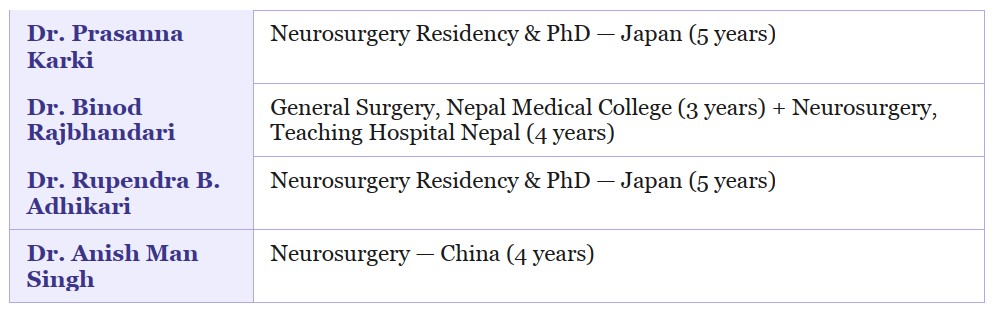
Across Continents, Held Together
They began together at Annapurna Neuro Hospital, Maitighar — one of Nepal's dedicated neurology centers — working as medical officers, learning the rhythms of neuro patients, sharpening each other through debate, late nights, and the quiet discipline of a specialty that demands everything you have. Then life sent them outward across the world.
Dr. Prasanna Karki and Dr. Rupendra B. Adhikari each traveled to Japan, where they spent five demanding years completing their neurosurgery residency and earning their PhDs — years of precision, discipline, and the relentless pursuit of mastery in some of the world's finest operating theaters. Dr. Binod Rajbhandari began with three years of general surgery in Nepal, then added four years of neurosurgical training at Teaching Hospital, Nepal. Dr. Anish Man Singh traveled to China for four years of neurosurgery training, immersing himself in one of the world's most prolific neurosurgical environments.
The years apart did not separate them. Across time zones and continents, across busy residency schedules and language barriers, they stayed in contact — sharing cases, sharing doubts, sharing the vision they had first articulated over cold canteen tea. The dream did not dim with distance. If anything, it grew sharper. They were each becoming the surgeons Nepal needed. And they were doing it together, even while apart.
The Bandage and the Wound
When they returned — trained, credentialed, experienced — they found themselves operating, consulting, healing. And they found themselves, once again, sitting with an uncomfortable truth. A surgeon's life is an extraordinary one, but it begins, always, at the end of someone else's suffering. By the time a patient reaches the operating table, something has already gone terribly wrong. The stroke has already happened. The tumor has already grown. The disc has already herniated and pressed and damaged.
They began to use a phrase among themselves that said everything: treating patients is like using a bandage to cover a wound. It helps. It is necessary. But it does not stop the next wound from opening. Prevention — real, community-level prevention — was the only answer. And prevention required awareness. The canteen conversations had never really ended. They had simply been paused for a decade of training. Now, with the skills to back the dream, they returned to the question they had always been asking: How do we reach people before it is too late?
A Foundation Is Born
Two years ago, Neurocare Foundation Nepal became real — not as an idea, not as a conversation, but as an institution with a name, a mission, and four founding neurosurgeons who had been preparing for it, without quite knowing it, for most of their professional lives.
Through the foundation, they have launched free health camps that bring neurological care to patients who cannot reach it on their own — people in communities where a neurosurgeon has never set foot, where the journey to Kathmandu is a financial impossibility, where diagnoses that could change a life have simply never been made. They have spread awareness about brain health and the prevention of neurological disease, about stroke — that it is a medical emergency, that the prayers must wait, that
the hospital cannot. They have worked to dismantle, one conversation at a time, the misconceptions that have cost Nepal's patients so dearly for so long.
And they are only beginning.
“We have much more dream to be fulfilled.”
On this World Brain Tumor Day, four neurosurgeons who were once four exhausted medical students — sitting together in a hospital canteen, refusing to accept that suffering was inevitable — ask Nepal to join them. To learn the signs. To seek help early. To understand that the brain, which holds everything you are and everyone you love, deserves to be protected not just by surgeons, but by all of us.
The wound they saw as students is still there. But now, at last, they have something better than a bandage.
Media Coverage
- Four Nepali neurosurgeons mark World Brain Tumour Day, renew call for public awareness on brain health
- How four neurosurgeons born of the same canteen, the same dream, and the same heartbreak-built Nepal’s Neurocare Foundation
- How four neurosurgeons born of the same canteen, the samedream, and the same heartbreak-built Nepal’s Neurocare Foundation
NAVIGATION
NEWS
address
© 2024 Neurocare Foundation Nepal | Design by Codearks Inc.